Source: Ryan Rutherford
Paul Gallagher
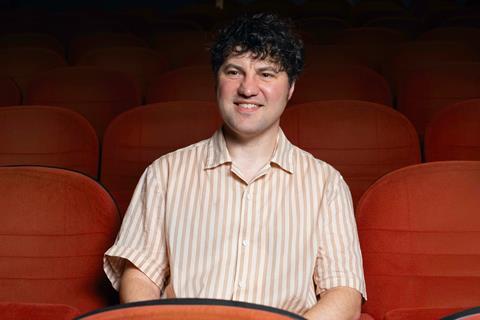
Paul Gallagher is leading his first Glasgow Film Festival (GFF) as head of programme after Allison Gardner stepped down from her dual role of festival director and CEO of Glasgow Film in October, after 30 years at the organisation.
“It’s no small thing,” Gallagher says of stepping into Gardner’s shoes or, more accurately, shoe: Seonaid Daly has taken over the role of chief executive at Glasgow Film, while Gallagher will concentrate on the festival.
For his first edition, Gallagher’s priority is to deliver a festival familiar to its loyal audiences.
“There’s a structure in place that I didn’t want to pull the rug out from under,” he says.
However, he admits he has made a few small tweaks, including a programme advisor pilot scheme which brought on four local programmers who each selected four films from different specialist areas.
“It’s important Glasgow has a locally recognisable programming voice. It’s got to be relevant to this city and what’s happening here,” Gallagher explains.
GFF opens tomorrow (February 25) with the UK premiere of Felipe Bustos Sierra’s documentary Everybody To Kenmure Street and runs until March 8, closing with James McAvoy’s California Schemin’.
Of the 126 features screening at the festival, 10 UK premieres from first- and second-time directors are in contention for the audience award, the festival’s only competitive category. The award is not backed by a sponsor this year after its two-year partnership with Mubi expired. “It’s something we hope to pick up after this edition,” Gallagher says of finding a new sponsor.
On the industry side, it is the festival’s biggest edition yet with highlights including a keynote speech from Curzon’s interim executive chairman Philip Knatchbull; a ‘made in Glasgow’ focus; and the launch of Scotland’s new Black Filmmakers Community Network (BFCN).
Scottish filmmaker Lynne Ramsay will also be in attendance to receive the festival’s Cinema City honorary award and participate in an in-conversation event for both industry and the public.
“Lynne Ramsay is one of a very small number of filmmakers who have the seemingly miraculous power of taking a unique vision in their minds and creating it onscreen exactly as they imagined,” says Gallagher. ”Her films have changed our understanding of what cinema can do and be.”
Going forward, Gallagher and Samantha Bennett, manager of GFF Industry Focus, are set to review how these strands can further complement each other.
“Having so many filmmakers and producers and sales agents and distributors in the city, we could definitely make more of that in terms of the public programme,” he explained.
Programme highlights
Gallagher points to several films in the festival which he is particularly excited for audiences to see. ”We have the world premiere of the Welsh-language drama, Effi o Blaenau. It’s really revelatory in terms of a young actress [Leisa Gwenllian] who just dominates the screen.
”Another one of our world premieres is again, a Gaelic language film, Psalms Of The People, so we’ve got all these indigenous UK language films.”
GFF is one of the first European festivals to take place after the Berlinale at which political debate and issues of free speech were front and centre. Gallagher says he and the team are gearing up for issues to be raised by filmmakers and audiences in Glasgow.
”It is important to prepare and be responsible for hosting civil conversations within a festival context,” he says of how the festival is working with moderators. ”We are thinking about how best to do that, and ensuring any host of an event feels prepared and feels easy to be able to have a conversation that’s going to be beneficial to audiences and to everyone involved.
”My hope, and my experience of previous Q&A’s and festival experiences, is that it’s a place where people want to hear what creatives have to say. They want to hear what the filmmakers they love, and filmmakers they’re just discovering, think and feel about things. It’s important to be able to, where appropriate, disagree constructively.”
Looking ahead
Highlighting the city of Glasgow has always been essential to the festival, with this year’s opening and closing titles having both filmed in the city. Gallagher is expanding even further. After the closure of Cineworld Renfrew Street, one of GFF’s key site partners, last year, many of the screenings are taking place at the Odeon Quay for the first time — a venue south of the river.
“It’s great to be able to expand the footprint south side in a way that we haven’t really significantly done previously,” Gallagher says. “All of this is obviously funding dependent, but it would be interesting to be able to look at widening the sort of geographical scope and across the city.”
As for further plans, Gallagher is holding off until his first edition is done and dusted. “There is potential for us to really define our place in that landscape of festivals,” he does reveal, however. ”That question of where GFF fits in the national picture of festivals and the international picture of festivals, and where we can appropriately and realistically aim to be.
“That’s something that excites me, because we can really get into that and properly answer that. It’s in a great place right now, but it can definitely grow and move to the next level.”