This article appeared in the February 6, 2026 edition of The Film Comment Letter, our free weekly newsletter featuring original film criticism and writing. Sign up for the Letter here.
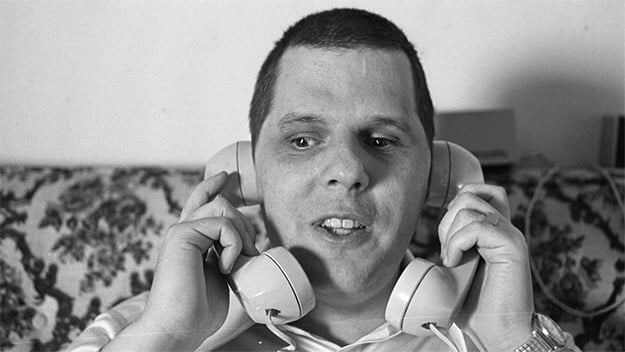
Joybubbles (Rachael J. Morrison)
I hate closings, so it was a no-brainer for me to take the remote option for the last Sundance in Park City, Utah. I have been attending the festival virtually since the COVID-19 pandemic anyway, and although there are aspects of being on the ground with friends who make, distribute, and write about movies that I greatly miss, I knew that Sundance as I had experienced it every year from 1989 to 2020 would go out with neither a bang nor a whimper. Indeed, a near-monopoly on banging and whimpering is at this moment held by those reporting the daily news from Minneapolis, Kyiv, Gaza, and Sudan. Nothing can compare—and for me, at home, nothing did. I know that Sundance will stage a comeback in Boulder, Colorado; that the indefatigable Michelle Satter will make sure the Sundance labs, which are as essential as the festival, will continue to discover and support talented directors, writers, and producers; and that David Linde, with his long, honorable history in independent film, is a very good choice to run the entire shebang.
But I suspect that without its founding father Robert Redford, who died in 2025, Sundance will become just another film festival, a place where movies are anointed with prizes and reviews that are useful in press releases and might make a distributor and/or streamer throw an unknown a lifeline. What has distinguished Sundance is that it was created by a film star—one of the last and greatest of them—who believed, somewhat paradoxically, that the value of a movie was not determined by box-office receipts but by the community it built. When your movie was shown at Sundance, or when you watched movies at the festival, you were part of that community, even if part of you rebelled against it. After all, “Ordinary Bob” was something of a rebel himself.
Most of the indelible memories I have of Sundance are of screenings that thrilled me: Richard Kelly’s Donnie Darko in 2001, Todd Haynes’s Safe and Larry Clark’s Kids in 1995, and Jane Campion’s seven-hour hour cable series Top of the Lake in 2013, shown with only a couple of short breaks so almost no one had a chance to pee because the Egyptian Theater had just two bathrooms. Most of all, however, I remember arguing with Redford sometime in the mid-’90s after I had been on a panel with him. He had been disturbed when I had said, like a grad student enamored of Althusser, that we are “fixed in ideology.” He could not accept that we had no conscious choice in the matter. I tried to explain that I was bothered by the way that Sundance believed in “story” as an absolute. He disagreed, but he never held my position against me. At one point in the trailer that opened many of this year’s screenings, Redford, in voiceover, says, “It is my hope that if we can give people the opportunity to express the unexpected perspective, then that will open eyes and minds.”
By all accounts, among the best films at Sundance 2026, an edition that affirmed Redford’s idea of “the unexpected perspective” several times over, was Once Upon a Time in Harlem, which I saw about a year ago at a work-in-progress screening, but sadly wasn’t available to me as a remote attendee in its finished form. In 1972, William Greaves, a pioneering documentary producer and director best known for his wildly and cannily reflexive Symbiopsychotaxiplasm: Take One (1968), invited still-vital artists and thinkers of the Harlem Renaissance to a party, where they reminisced, argued, and revived a storied past into an exciting present. Greaves, who died in 2014, never found a form for the moving-image history he had collected, but his son, David, who had been part of the 1972 shoot, was determined to turn many hours of 16mm footage into a feature. The result, based on what I’ve seen of it, is brilliant.
By far the most impressive film I saw remotely was the winner of the World Cinema Dramatic Competition: Shame and Money by the Kosovo-born, Germany-based director Visar Morina. The superb actors Astrit Kabashi and Flonja Kodheli play Shaban and his wife Hatixhe, who run a small dairy farm, but are forced to move to the city when their cows are stolen by Shaban’s renegade brother. The couple want only to work hard and provide for their kids and Shaban’s mother, but Shaban is undermined and pushed to the breaking point, to put it bluntly, by ruthless capitalism and the hypocritical class system. Morina’s style is straightforward, with long takes that rely on the expressivity of his actors and the potential of the situation to explode in violence. It should take nothing away from the specificity of Morina’s work to say that I was often reminded of early Fassbinder and Cristi Puiu.
A more stylized critique of power, Rafael Manuel’s first feature, Filipiñana, won a special jury award for creative vision and has been acquired by Jia Zhangke’s new film-distribution company. Set on a vast country-club golf course, a legacy of the American occupation of the Philippines, it is a devastating coming-of-age story focused on a teenager, whose job as a “tee girl” exposes her to exceptionally cruel and perverse exploitation.
As usual, documentaries were a safer bet than the fiction films. Two pleasurable examples, Rachael J. Morrison’s Joybubbles and David Shadrack Smith’s Public Access, deserve a post-Sundance life. Morrison’s portrait of the late Joe Engressia, aka Joybubbles, is a bittersweet construction of home movies, still photos, newspaper clippings, interviews, and, crucially, recordings of Engressia’s voice, which bears a striking similarity to that of David Lynch. Engressia, who was born blind, learned almost by chance how to connect to the world by telephone. Possessing perfect pitch, he could whistle tones in the exact frequencies that rotary phones employed in their dialing system. An instigator of the “phone phreak” subculture, Engressia was first prosecuted by the feds for wire fraud but later became a valued phone-company employee, and, in his last years, began a phone call-in service through which he connected with people who needed to hear a friendly voice on the line. Morrison is too smart to label Joybubbles as the forerunner to the titans of social media, although she includes a priceless clip of the young Steve Jobs and Steve Wozniak (themselves inspired by Engressia) toying with the famously illegal “blue box,” which hijacked long-distance phone networks by mimicking their signal tones. Joybubbles has the making of a minor cult classic.
Another exploration of what now seems like primitive tech, Public Access focuses on Channel C, which was born out of the requirement that Manhattan Cable Television, a subsidiary of Time Inc., give something to New York City in exchange for commercial cable rights to much of the metropolis. Channel C was a showcase for the downtown music and art scene of the late ’70s and early ’80s, from Pat Ivers and Emily Armstrong’s Nightclubbing videos and Glenn O’Brien’s TV Party to more salacious spectacles promoted by Screw Magazine’s Al Goldstein in the name of freedom of speech and information. Perhaps Channel C’s most valuable effort was hosting Paper Tiger TV, a no-budget news series crafted by video- and filmmakers who put politics above artistic niceties. Public Access covers a lot of ground without very much depth, but it is a pretty good primer for a too-long-neglected New York City subculture.
Other notable documentaries I chanced upon were Janay Boulos and Abd Alkader Habak’s Birds of War, Jason Osder and William Lafi Youmans’s Who Killed Alex Odeh?, and Selina Miles’s Silenced. For decades, Sundance, in addition to its support of American independent film, has jump-started international documentaries like these three. May it continue to do so in the future.
Amy Taubin lives in New York City, where she writes about movies and art.