
This article appeared in the February 6, 2026 edition of The Film Comment Letter, our free weekly newsletter featuring original film criticism and writing. Sign up for the Letter here.
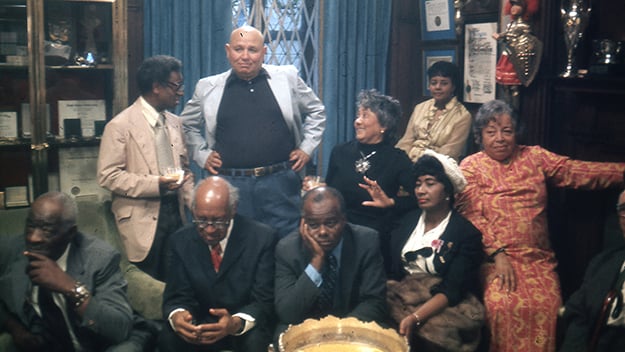
Once Upon a Time in Harlem (William Greaves and David Greaves)
The Sundance Film Festival has long been full of contradictions. As Abby Sun wrote for Film Comment last year, from its origins as the Utah/U.S. Film Festival in the late 1970s, the event’s M.O. has been a kind of Trojan horse: “use star guests to elevate new independent voices.” That has always been a delicate ploy, but in the eight editions that I’ve attended (including two virtual editions in 2021 and 2022), it’s been increasingly hard to tell if the star power is illuminating or outshining the films poised for discovery. Over the years, I’ve managed to forage some true gems in the Park City lineups—Garrett Bradley’s America, Savanah Leaf’s Earth Mama, Raven Jackson’s All Dirt Roads Taste of Salt, Aaron Schimberg’s A Different Man, and Rich Peppiatt’s Kneecap all come to mind—but this year, the number of glitzy titles one had to wade through to get to the smaller, bolder films by newer filmmakers felt especially daunting. The official Sundance tote’s placement of the Disney+ logo directly below the words “Proudly Streaming Independent Cinema” was appropriately pungent with irony.
The festival’s logistics don’t help. While the Sundance audience has grown in size in recent years, its venue options have shrunk. I lined up nearly 100 minutes in advance for the press-and-industry screening of John Wilson’s (very good) The History of Concrete—a window of time in which I could have easily watched a film like Walter Thompson-Hernández’s If I Go Will They Miss Me. Thankfully, I managed to catch Thompson-Hernández’s gentle, thoughtful sophomore feature on a link after a friend enthusiastically recommended it to me. Time lost in queues or on buses stuck in traffic near the corporate-lounge fantasia that is Main Street, along with exorbitant costs of attending the festival (easily upwards of two grand for a weeklong stay, unless you squeeze into the bottom bunk of a bunk bed with a friend, as I did in 2019), add to the discomfort of the freezing cold of Park City in January. This can make the lineup’s usual preponderance of formulaically quirky films, many of them workshopped into banality and already stamped with studio logos, feel like assaults to one’s morale.
All of which is to say that if next year’s relocation to Boulder, Colorado smooths out any of these aspects of attending the festival, I’m all for it. But of course, Sundance itself is only part of the problem—the film business itself, marked by the agglomeration of corporations and the gutting of public arts funding, is becoming an increasingly unfriendly place for independent art unconstrained by the bottom line.
Fittingly, some of the buzziest titles in this year’s lineup grappled, self-reflexively, with the travails of the so-called culture industry—and some were actually pretty good. In Gregg Araki’s 11th (!) selection at Sundance, I Want Your Sex, the Totally Fucked-Up relationship between a wily dominatrix-artist, Erika Tracy (Olivia Wilde, exuding maleficence), and her young, milquetoast gallery assistant, Elliot (a perfectly puppy-faced Cooper Hoffman), becomes an occasion to explore both the unassimilable complexities of desire and the moneyed pretenses of the art world. The BDSM scenes are somewhat tame for an Araki film—the real seduction here is in plays of power, rather than adventures of the flesh. Elliot’s manipulation and humiliation at the hands of Erika is real, but also kinda hot, as he says at one point to a pair of cops. (Meanwhile, a fellow assistant at the gallery is shocked to hear that he doesn’t have a trust fund: “Are you an… orphan?”) Amid all of the witty one-liners, wild hijinks, and campy performances, there is something here that cuts through the moral hand-wringing of the sex-in-cinema discourse: a profound reflection on the ways in which an overly prudish society denies us self-knowledge, while a brazenly capitalist society denies us self-respect.
The same cannot be said for Cathy Yan’s The Gallerist, a ham-fisted and smug caper about a corpse turned, improbably, into a hot item at Art Basel. But one scene, in which two wealthy men drive up the price of the piece to obscene heights in a bidding war, hit close to home at the festival. When you see studios shelling out $12 million to buy a single film, like Olivia Wilde’s The Invite, you do wonder what’s left to go around. That, partly, is what John Wilson gets at with his debut theatrical feature. The schtick, as he narrates it in the opening minutes, is that in an attempt to follow up on the success of his HBO series, How To with John Wilson, he set out to make—and find financiers for—a movie about a substance so omnipresent and essential as to be almost invisible: concrete. Wilson’s methods here are a little too familiar from the TV show—ironic visual and verbal observations strung together into an associative, often rollicking ride—but The History of Concrete is still an unadulterated pleasure. Wilson’s genuine, indefatigable curiosity, as well as his “yes, and” tendency to follow a thread wherever it leads, is invigorating. Just by looking a little harder than the rest of us at the places and people around us, he finds endless eccentricities, novelties, and stories: a worker at a concrete company and aspiring actor, whom we follow onto a short-film set; a guy who removes chewing gum from sidewalks and also sells speciality “Gum Buster” wine; a Writers Guild of America workshop for writing Hallmark rom-coms whose hackneyed insights become recurring gags.
At one point in Wilson’s on-screen quests to find a funder, he receives an offer conditional upon the inclusion of a storyline about a musician of considerable renown, given that celebrity biopics about music stars are currently all the rage. Charli xcx deals with similar demands in her music-and-film-world satire The Moment. Directed by Aidan Zamiri and produced by the pop star, the film finds Charli contending, Wilson-like, with staying relevant after the long-overdue and overwhelming success of her 2024 album brat. While she prepares for her biggest world tour ever, her label strikes a deal with Amazon MGM Studios for a documentary, and hires a director (played by Alexander Skarsgård) of anodyne, widely streamed concert films. The allure of mass appeal clashes with the 365 party girl’s brash and provocative brand in a quick-witted film that moves and pulsates to the rhythm of Charli’s club music. Just when you think the movie is slipping into poor-little-rich-girl sentimentality, it takes a swerve that is refreshing in its black-comedic cynicism—particularly in a streaming landscape crowded with docs by and about pop divas that aggrandize their girlboss achievements (cf: Jennifer Lopez, Beyoncé, Taylor Swift…).
The late director William Greaves said as far back as 1995 that, “unhappily, the world seems progressively oriented to the bottom line, and the impact on cinema is devastating. It sure plays havoc with my truth.” Yet Greaves was one of those rare auteurs who found ways to preserve his truth even in a ruthlessly changing industry, working on innumerable TV documentaries and educational films on commission (many of which, like the public-affairs news show Black Journal, proved pioneering in their own right) so he could make his passion projects, including the utterly singular Symbiopsychotaxiplasm: Take One (1968). One such project of his, however, never saw the light of day during his lifetime due to funding issues. In 1972, Greaves invited many of the living luminaries of the Harlem Renaissance—actor Leigh Whipper, socialist leader Richard B. Moore, poet Arna Bontemps, photographer Jack Van der Zee, and others—to Duke Ellington’s home for a party. As the guests, dressed to the nines, hobnobbed and reminisced about that extraordinary and hard-won period of African-American cultural flourishing, Greaves, along with his son David and three other cameramen, filmed them. That footage lay in Greaves’s archives until David and his daughter Liani Greaves restored and restitched it together into a resplendent verité documentary: Once Upon a Time in Harlem, which premiered at this year’s Sundance.
There is much to admire in this brilliant movie, self-reflexive in its own way but without the taint of irony: rich colors; roving and intimate camerawork; the careful sequencing of party scenes interspersed with talking-head interviews with various guests; the use of poetry, which adds a timeless dimension; and the discussions themselves, which oscillate with remarkable ease between irreverence and intellectual rigor, between drunken revelry and serious political debate. The overwhelming effect of watching Once Upon a Time in Harlem is that of receiving a gift—a rare, doubly retrospective look back at the zeitgeist of the 1920s through that of the 1970s. It’s as if the ghosts of elders, who saw and knew so much, have been summoned so they can share their wisdom with us. It makes you wonder: how many such figures, how many such stories, are gathering dust in vaults, or worse, lost to the winds of time? Harlem is a reminder that cinema is much more than a commodity or a source of entertainment. It is a kind of embalmment, and a missive to posterity.
Among the discoveries at this year’s Sundance, two under-the-radar titles, both father-son tales, stood out to me. Closure, the latest nonfiction feature by Polish director Michał Marczak, follows a father’s relentless search for a teenage son who went missing over a year before with remarkable intimacy and elegance. Where true-crime narratives—the other current doc-industry fad, alongside celeb portraits—fixate on the who, where, and why of it all, Closure deals with what it means to live without neat explanations and confront the unknowability of other people, even those we love. If I Go Will They Miss Me, which premiered in the NEXT section for innovative indies, is also a film that evades simple answers. Set in the Watts neighborhood of Los Angeles, it traces the fraught relationship between Lil Ant, a boy who loves to daydream and draw, and his dad Big Ant, who has just returned from a long stint in prison and struggles to inhabit the roles of father and husband. The film is a quiet, wrenching meditation on masculinity that holds two truths at once: individuals have agency and responsibility over their actions, and they are also products of their circumstances. It challenges us to find the kind of empathy that the prison-industrial complex disallows—one that isn’t conditional upon people’s pasts, but rather, is resilient in its hope for their futures. If Once Upon a Time in Harlem, Closure, and If I Go Will They Miss Me find the audiences they deserve, then there still might be something worth rooting for in this biz after all.