
Withering Lows
By
Genevieve Yue
on
February 17, 2026
This article appeared in the February 13, 2026 edition of The Film Comment Letter, our free weekly newsletter featuring original film criticism and writing. Sign up for the Letter here.
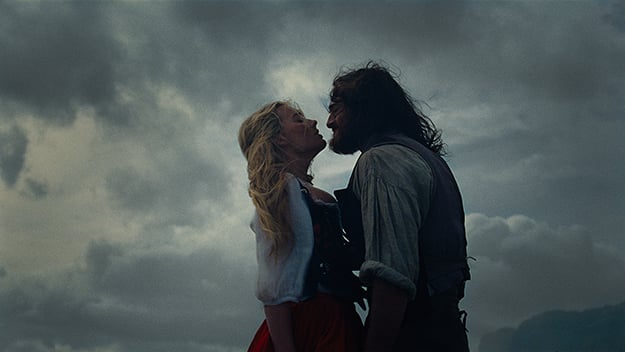
Wuthering Heights (Emerald Fennell)
I’m going to start with a spoiler, because we’re talking about a nearly 200-year-old novel with more than a dozen film adaptations: there is no corpse-fucking in Emerald Fennell’s Wuthering Heights.
Granted, in Emily Brontë’s story, the corpse-fucking is only implied as the logical next step after a character digs up a coffin, rips open one side, and lies with the partially decayed body inside. All of this is of course shocking, but it is carried out with undeniable passion. For me, this is the measure of any Wuthering Heights adaptation: its willingness to become what Brontë contemporary Dante Gabriel Rossetti called “an incredible monster.”
Fennell’s monsters—the doomed lovers Cathy (Margot Robbie) and Heathcliff (Jacob Elordi)—are comparatively vanilla. And besides the bonkers set design, amply splashed with crimson, it’s hard to recognize the director of the brash and provocative Promising Young Woman (2020) and Saltburn (2023). Maybe it’s the Brontë mountain Fennell’s trying to climb, or maybe, as a millennial director settling into middle age, she’s aged out of her edge. Or maybe, because it’s 2026, and we are all so very tired, it’s that we are getting the Wuthering Heights we deserve: a limp one. The film adapts the first half of the story, in which a young Heathcliff is brought by Mr. Earnshaw (Martin Clunes) to Wuthering Heights, the family estate on the barren West Yorkshire Moors. It follows the bond that develops between the boy and Earnshaw’s daughter Cathy, first as children, then as adults. After a series of misunderstandings, Cathy marries the rich Edgar Linton (Shazad Latif), and to spite her, Heathcliff weds Isabella (Alison Oliver), Linton’s ward. (She is his sister in the novel.) Cathy gradually weakens and dies, ostensibly of a broken heart, and upon her death Heathcliff demands that she return as a ghost, forever to torment him.
Fennell’s version is significantly pared down. She sheds key characters, including Cathy’s brother Hindley, whose early cruelty to Heathcliff inspires his lifelong campaign of vengeance, and alters important details, like Heathcliff’s ethnic ambiguity. In this film, he is not called a “gipsy”; there’s no Hindley around to say the word. Hindley’s antagonism is instead divided between two characters: Mr. Earnshaw, now a generically abusive dad, and Nelly (Hong Chau), the Earnshaws’ servant in the book, who schemes to keep Cathy and Heathcliff apart. She gets a class upgrade to companion, and she would be a lady were it not for her illegitimate birth (apparently by an Asian parent? I can’t tell whether the casting is blind to race or uses it decoratively). The source of Heathcliff’s animus has all but disappeared, and so too have the stakes of his relationship with Cathy. Instead of its fated impossibility, as it is conveyed in the book, their union is impeded by silly contrivances.
Brontë’s Cathy and Heathcliff are like forces of nature. Both are described as “wild”: Cathy, “a wild, hatless little savage,” and Heathcliff, “an unreclaimed creature, without refinement, without cultivation; an arid wilderness of furze and whinstone.” They cannot be controlled, even by their own selves. Fennell gives us toy versions. Her Heathcliff patiently takes lashings from Mr. Earnshaw and waits out Cathy’s bouts of temper. Despite Elordi’s hard abs, visible underneath a persistently rain-soaked shirt, his Heathcliff is strangely soft. Cathy, meanwhile, may be spirited and sharp-eyed, but she never really outgrows her girlishness. She’s understandably attracted to Heathcliff after he returns from a prolonged absence—who wouldn’t be, especially now that he’s sporting an earring and a gold tooth? But is it a matter of amour fou, or the marital boredom Cathy complained of in the previous scene?
Surely Fennell has the right to make her own version of the novel—that’s what the quotation marks that adorn the film’s official title are for. But that doesn’t mean she has crafted a good film, even on its own terms. The problem with a “reimagining” of this sort is not too little source material, but too much of it. The excisions and substitutions throw the work off-balance. Scrubbed elements leave a residue, while remaining ones totter in the absence of their previous supports. Nelly is mad about something, but it’s never clear what she’s after. When Heathcliff first arrives, she seems jealous, but why? Later, after Cathy upbraids her with a stinging remark, she prompts Cathy to admit that marrying Heathcliff would “degrade” her, knowing all the while that Heathcliff is listening on the other side of the door. In the novel, this pivotal scene is described by Nelly herself, the book’s narrator. If she acted maliciously, she did not do so consciously. Here, her snap retaliation is just petty.
Fennell offers no motivation for Nelly’s behavior, or really that of any character besides Cathy and Heathcliff. Those two love each other, and are horny for each other, which is reason enough to keep the story going, though when and how those feelings bloomed are left unexplained. Everyone else is just set dressing, there only to move forward or stall the central relationship. This is a shame, because Fennell’s most interesting character is Isabella. In the novel, she is the innocent victim of Cathy and Heathcliff’s sick games, but here she is granted a surprising sturdiness. Her eccentricities are played for laughs, but she relishes everything she does. She loves ribbons—she has an entire room dedicated to ribbons!—and naughty découpage. She makes creepy little dolls with bits of Cathy’s hair, then stages them in an enormous dollhouse, an exact replica of the Lintons’ home. (Their mansion’s hallucinatory décor, a mix of Hollywood Regency and what could be called “putrid fairy tale,” seems also to have come straight from Isabella’s imagination.) When Heathcliff bursts through her window with a loveless offer of marriage, she obliges with full consent. This is the kinkiest moment in the film—and certainly sexier than the steamy bodice-ripping promised in the film’s promotional materials. In the shadow of Heathcliff’s tortured relationship with Cathy, he forges one with Isabella that, despite or perhaps because of its depravity, is honest.
To her credit, Fennell understands that it’s more fun to smash a dollhouse than to construct one meticulously. Her sledgehammer approach to party scenes in her previous films is rivaled by Wuthering Heights’s opening sequence of a public hanging. Though we are supposed to be in the late 18th century, the mood is more medieval. After a few moments of the hanged man’s dying gasps, a Charli xcx song floods the soundtrack (the truly terrifying track “House,” which she recorded with John Cale), and the crowd erupts in a carnal frenzy. People roar, some start fucking, a nun closes her eyes, and parents pull away their children. The scene does not exist in Brontë’s novel, but it’s somehow closest to the monstrous vitality of that world, a place where the dead refuse to die. Too bad that Fennell never gives her characters the chance to live.
Genevieve Yue is an associate professor of culture and media at The New School, and the author of Girl Head: Feminism and Film Materiality (2020) and Trains, due out in fall 2026.